Momentum day trading
How day traders find the one stock in play, build a morning watchlist, and plan every trade before the open.
What day trading really is
A day trader opens and closes positions inside the same session and ends the day flat. No overnight risk, no long-term thesis. The entire job is finding a stock that is moving today, with enough volume to get in and out, and trading it with a plan written before the entry.
The stock in play
Momentum day traders do not trade whatever they happen to like. Each morning they look for the one or two stocks the whole market is watching, often called the stocks in play. The classic checklist has five points:
- A real catalyst. News released overnight: earnings, a drug trial result, a contract, a filing. The move needs a reason.
- A big gap. The stock is already trading well above yesterday's close in the premarket, usually up 10% or more.
- High relative volume. It is trading many times its normal volume. A stock that usually trades 300k shares and has printed 5 million before the open has everyone's attention.
- Low float. Fewer shares available to trade means the same buying pressure moves the price further and faster.
- A workable price. Many momentum traders focus on the $2 to $20 range, where a one dollar move is a meaningful percentage.
Crypto has the same idea with different words. A coin that announces an exchange listing, jumps 15% in an hour and prints ten times its usual volume is a coin in play.
A gap and go morning, on the chart
The chart below is a simulated but realistic 5-minute chart of the pattern this playbook is built around. Yesterday the stock drifted around $4. News hit overnight, it gapped up, drove higher at the open, pulled back once, then continued. Hover the candles, scroll to zoom, and drag to pan.
The morning routine
- Before the open, scan for the biggest gappers with news and high relative volume.
- Cut the list to two or three names. More than that cannot be watched properly.
- For each name write down the premarket high, yesterday's close, and the price where the idea is wrong.
- Plan the trade: entry trigger, stop, target of at least twice the risk. If the plan cannot be written, the trade is skipped.
- After the session, journal every trade: the setup, the result, and whether the plan was followed.
Why beginners lose
- They chase a stock that is already up 80% because it is exciting, with no entry trigger and no stop.
- They risk far too much on one trade, so one mistake erases a week of gains.
- They skip the simulator phase and pay the market for lessons a demo account would have taught for free.
- They trade all day. The edge in this playbook is concentrated in the first hour, when volume is highest.
What extension looks like for real
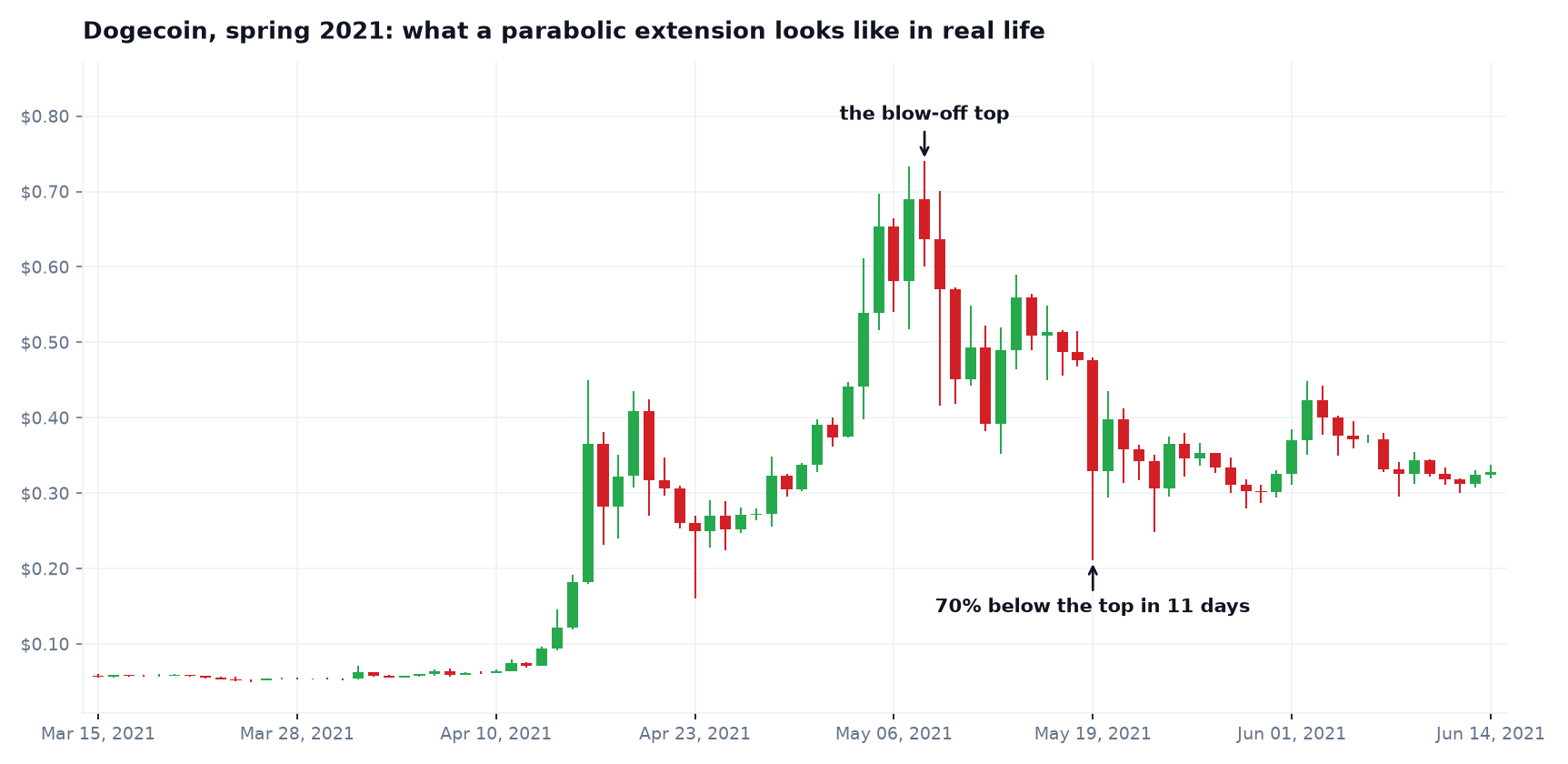
Dogecoin in spring 2021: a coin in play for weeks, roughly ten times higher in two months, a blow-off top on the most euphoric day of the run, then 70% given back within eleven days. Momentum traders study charts like this to remember both halves of the story. The run was real. So was the ending.
Study it with CryptoAlertly
- Use a percent move alert on the assets you follow, for example 10% in 24 hours, so the movers come to you by email instead of you scanning all day.
- When something is in play, set a price alert at the premarket high or the breakout level you wrote down, and treat the email as the signal to go look, not to blindly buy.
- Practice the patterns risk-free in the simulator before any real money is involved.
- Be honest about speed: alerts here are checked every two minutes, which suits planning levels and catching movers, not split-second scalping.
Turn this into real alerts
Free plan, no card needed. Set a price target and we email you when it is crossed.